 Savefinance
: cTokens for deposits
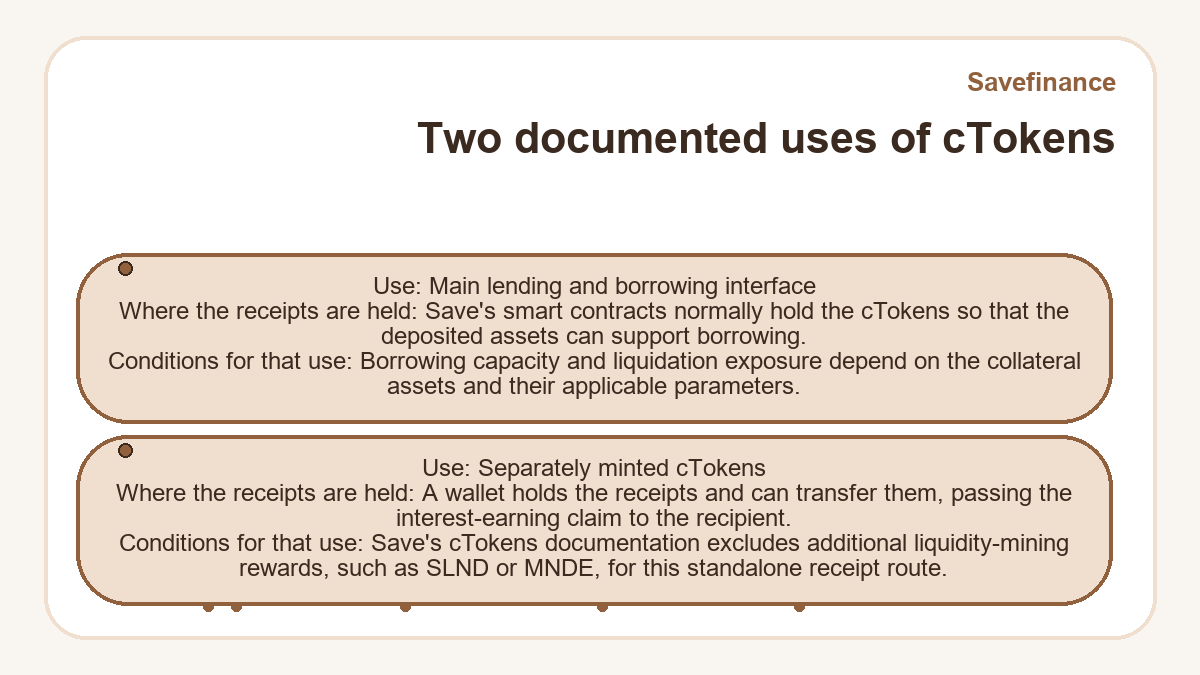
Save, formerly Solend, uses cTokens as yield-bearing deposit receipts in its Solana lending protocol. These receipts represent an interest-earning position in a lending reserve. The main lending and borrowing interface normally holds them in smart contracts for use as collateral, while separately minted cTokens can be held in a wallet or transferred to another holder.
How interest changes a receipt's value
USDC is an underlying lending asset; cUSDC is its deposit receipt. The receipt connects a transferable token balance to the assets accounted for in the reserve.
For cUSDC, Save defines the exchange ratio as total reserve USDC divided by circulating cUSDC. That ratio expresses how much USDC each cUSDC represents. As the reserve accrues interest, the same cUSDC balance can represent more underlying USDC. The lending rate varies with borrowing activity and reserve parameters, so holding the receipt does not lock in a fixed return.
Wallet-held receipts and borrowing collateral
| Use | Where the receipts are held | Conditions for that use |
|---|---|---|
| Main lending and borrowing interface | Save's smart contracts normally hold the cTokens so that the deposited assets can support borrowing. | Borrowing capacity and liquidation exposure depend on the collateral assets and their applicable parameters. |
| Separately minted cTokens | A wallet holds the receipts and can transfer them, passing the interest-earning claim to the recipient. | Save's cTokens documentation excludes additional liquidity-mining rewards, such as SLND or MNDE, for this standalone receipt route. |
Why the SPL token format matters for integrations
cTokens are SPL tokens, so a developer can work with a transferable token that represents a lending deposit. The interest-bearing position can move between holders while remaining connected to the underlying reserve.
Save's developer introduction lists streaming yield-bearing cTokens for payroll and building fixed-yield protocols around cTokens as possible integration patterns. These are application ideas built around the receipt format, rather than evidence that a particular payroll service or fixed-yield product is deployed.
Transferring a receipt and withdrawing its underlying asset
A transfer changes who holds the receipt. Access to the underlying tokens also depends on liquidity in the lending reserve. When 100% of an asset's supply has been borrowed, withdrawals and further borrowing fail until repayments or new deposits restore available tokens. A transferable cToken therefore does not establish that its underlying asset is immediately available for withdrawal.
The receipt also remains exposed to risks in the lending system. A smart-contract exploit can steal or freeze funds, and market turmoil can produce bad debt when liquidated collateral does not cover outstanding loans. The SPL token format makes the position transferable; it does not remove those underlying risks.