 Savefinance
 permissionless pools
Save, formerly Solend, allows anyone to create an isolated lending pool on Solana. The market owner controls the pool's asset listings and settings, while the creator is responsible for ensuring that liquidators operate.
Who owns the market and its reserves?
A pool is a lending market containing one or more reserves. Each reserve corresponds to a listed asset and has its own lending parameters. Eligible deposits in one reserve can serve as collateral for borrowing another asset in the same pool, so a risky collateral token can put suppliers of other assets in that pool at risk. The wallet that owns the market has administrative authority over its reserves.
Save's pool interface identifies the market owner. The management guide describes an Edit pool control that appears when the connected wallet is the owner. A permissionless listing can be created outside the Save team's own listings, so the owner of the particular market matters.
Ownership can be transferred to another wallet or multisig, giving the recipient control over the market's reserves. The management guide warns that an ownership transfer to the wrong address cannot be recovered.
Which settings can the owner change?
- Asset listings
- Add an asset as a reserve or deprecate an existing token through reserve configuration.
- Collateral and liquidation settings
- Loan-to-value ratios affect borrowing capacity against deposited collateral. Liquidation thresholds determine when positions become eligible for liquidation.
- Borrow interest rates
- Reserve interest-rate parameters govern how borrow APR changes with utilization, including minimum, optimal, and maximum borrow APR settings.
- Deposit and borrow caps
- A reserve's deposit cap limits the quantity of its token that may be supplied, and its borrow cap limits the quantity that may be borrowed.
Updating a reserve can change the conditions affecting existing positions and may lead to liquidations. Reserve changes are observable on the blockchain and appear in the reserve changelog. The pool-management guide recommends that owners give users two weeks' notice before reserve updates.
How does a market-wide outflow limit affect its reserves?
A global outflow limit restricts the combined value that can be borrowed or withdrawn from a market during its configured period. Borrowing and withdrawals from different reserves share that market allowance. Reserve-specific outflow limits can apply alongside it.
Example: How do two requests share one allowance?
All inputs in this example are hypothetical. A pool with two reserves has $12,486 of remaining market-wide outflow allowance for the applicable period. A proposed borrow from one reserve is worth $7,140, and a proposed withdrawal from the other is worth $6,180. Assume the remaining allowance does not change while comparing the requests.
The proposed outflows total $7,140 + $6,180 = $13,320. They exceed the remaining allowance by $13,320 - $12,486 = $834. Reducing their combined value by at least $834 would bring them within that allowance, provided it remains unchanged. Both reserves draw on the same market limit, so splitting the requests between assets does not give each request a separate $12,486 allowance.
Each request remains subject to reserve limits and available token liquidity, with collateral requirements applying to the borrow and to any withdrawal of collateral backing an existing loan.
Who keeps pricing and liquidations working?
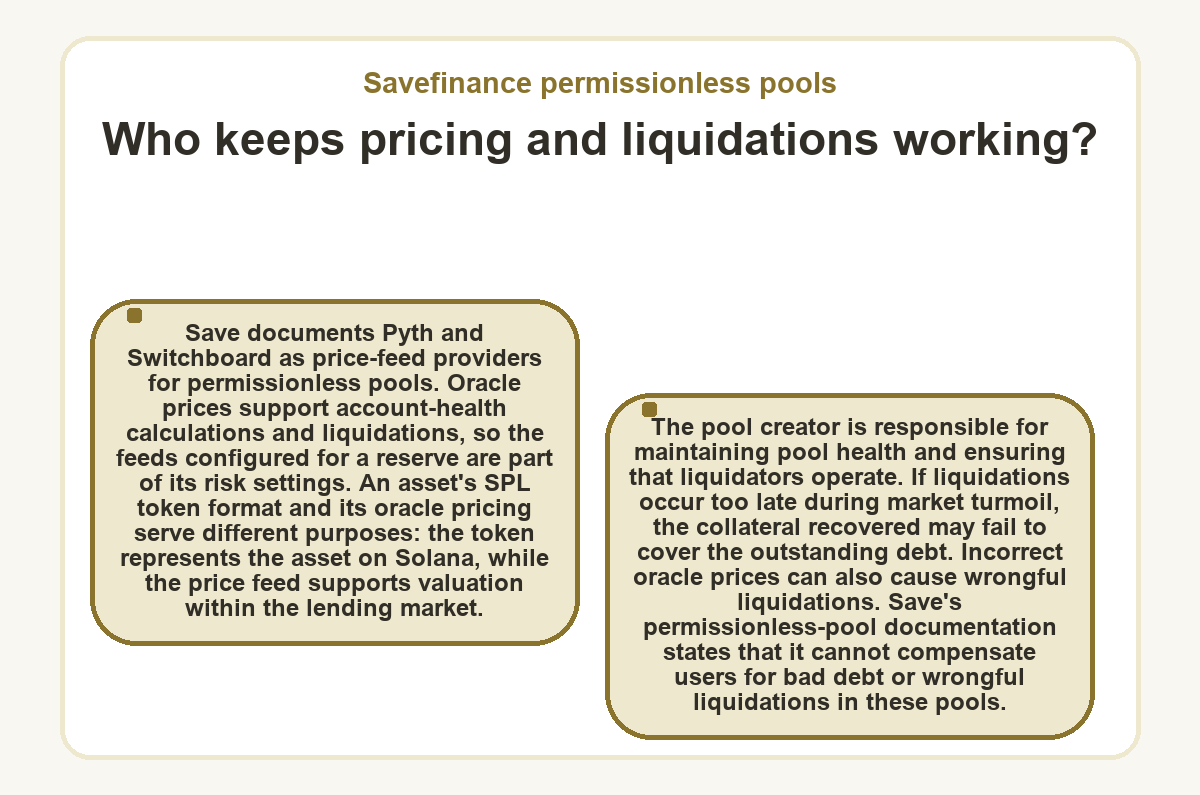
Save documents Pyth and Switchboard as price-feed providers for permissionless pools. Oracle prices support account-health calculations and liquidations, so the feeds configured for a reserve are part of its risk settings. An asset's SPL token format and its oracle pricing serve different purposes: the token represents the asset on Solana, while the price feed supports valuation within the lending market.
The pool creator is responsible for maintaining pool health and ensuring that liquidators operate. If liquidations occur too late during market turmoil, the collateral recovered may fail to cover the outstanding debt. Incorrect oracle prices can also cause wrongful liquidations. Save's permissionless-pool documentation states that it cannot compensate users for bad debt or wrongful liquidations in these pools.
How do creation charges and creator fees differ?
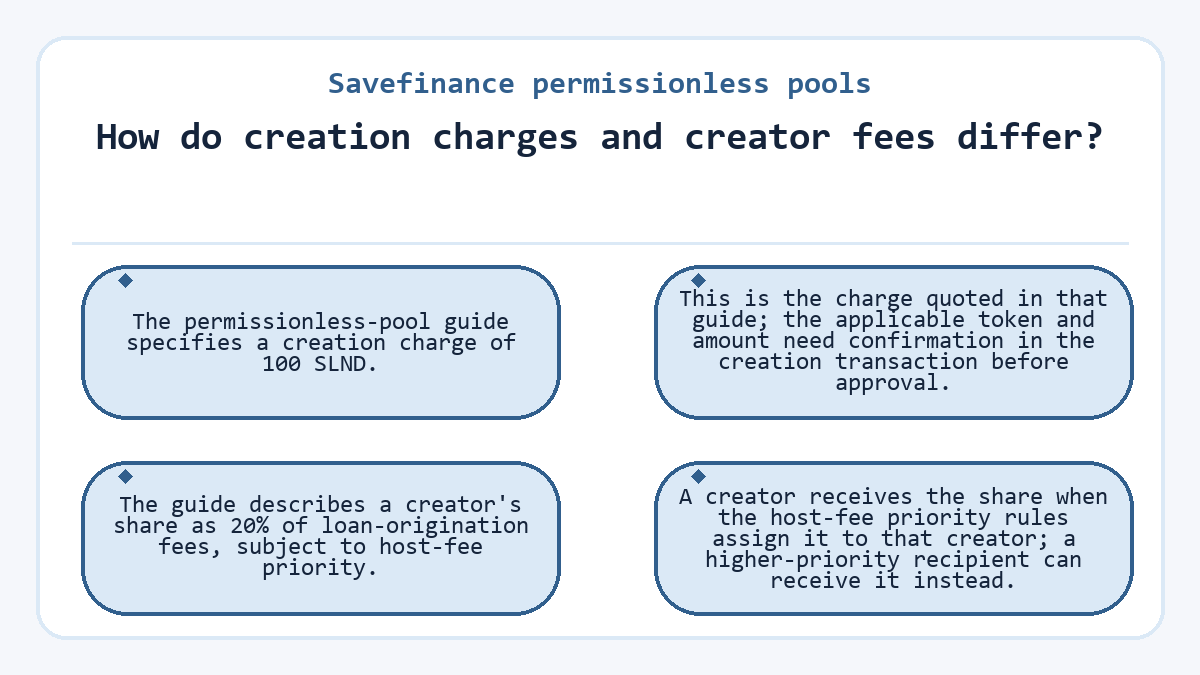
The permissionless-pool guide specifies a creation charge of 100 SLND. This is the charge quoted in that guide; the applicable token and amount need confirmation in the creation transaction before approval.
The guide describes a creator's share as 20% of loan-origination fees, subject to host-fee priority. A creator receives the share when the host-fee priority rules assign it to that creator; a higher-priority recipient can receive it instead.